


Interview with "It Was Just an Accident" Editor Amir Etminan


"It Was Just an Accident" had its worldwide premiere at the 2025 Cannes Film Festival and even won the top prize at the festival, the coveted Palme d'Or. Ever since, it has been receiving rave reviews from critics and audiences for its stunning craftsmanship and thrilling storytelling. Amir Etminan, the editor of "It Was Just an Accident," was kind enough to spend some time answering my questions via email. You can read the interview below. Please be sure to check out the film, which is now in theaters nationwide. It is an incredible film, one of the very best of the year. It is up for your consideration for this year's Academy Awards in all eligible categories, including Best Picture, Best International Feature Film, and Best Editing. Thank you, and enjoy the interview.
This is your second feature film collaboration, with director Jafar Panahi after
editing "No Bears." Could you talk about your collaboration with one another, how you were brought on to the project, and your initial thoughts on the script?
This project was actually my third collaboration with Mr. Jafar Panahi. If we also consider my previous projects with Mr. Panahi, where I worked as an assistant editor, and the film "Hit the Road" (directed by Panah Panahi), in which I served as the editor, our collaborations extend far beyond two or three projects. I have known Mr. Panahi for about five years, and it has always been an honor to work alongside him.
I was invited to join this project through one of his close friends, who informed me about the project and asked me to join the team on a specific date, emphasizing that I should carefully consider the potential risks before accepting. Despite these risks, having experience working under similar conditions, I gladly accepted.
Due to security concerns, I had migrated to Istanbul, Turkey, between the projects and had moved my entire editing system there. Therefore, being detained during the project could have resulted in a travel ban, which would have been extremely difficult for me as I was no longer living in Iran.
Two days before filming began, I traveled to Iran and my hometown of Salmas, and then drove to Tehran and the filming location, about eight hours away, joining the crew directly on set. Our previous collaborations had made us fully aware of each other’s workflow and preferences, allowing us to work in complete coordination.
A key point is that there was no complete written script. The version we had only included the basic structure of the scenes, while the main dialogue was intentionally removed due to political sensitivity and security concerns. Each day on set, Mr. Panahi provided the actors with the day’s dialogue to rehearse and perform, so that if the police or security forces arrived, no one on the team would be carrying the real script.
As a result, my focus was on both narrative structure, pacing, shot selection, and alignment with the director’s vision, as well as file security and workflow efficiency. These conditions required intense focus and precision, with daily quick decisions to achieve the best possible outcome.
"It Was Just an Accident" was filmed and edited on location in Iran and under restrictions and censorship from the government. Could you tell me about the constraints faced during production and the editing process?
The production of "It Was Just an Accident" took place under strict and constant restrictions. The most significant limitation was obtaining a filming permit. Since Mr. Panahi, as a politically outspoken filmmaker, is not allowed to officially direct a film in his own country, we had no choice but to work undercover. We secured a permit under the name of one of the crew members, registered as a short film with a fake scenario, just to begin shooting without drawing attention from the authorities.
As for me, the main challenge was the complete lack of internet access. Because Adobe services are blocked in Iran, simply connecting my laptop to the internet would deactivate my editing software. Therefore, from the moment I entered Iran until the end of the project, my laptop remained offline.
Beyond these technical issues, the entire team was under continuous security pressure: the risk of arrest, the possibility of being banned from leaving the country, and the danger of confiscation of the footage.
These threats shaped every aspect of our workflow—shooting, transporting footage, backing up material, and even basic movement from one location to another.
Yet, in a way, these restrictions gave the project a deeper emotional and creative dimension. The constant sense of urgency and the shared need to protect the film strengthened our commitment and became part of the soul of the movie itself.

Given the challenges of working under such circumstances, what editing software or workflow did you use, and how did those technical choices support your ability to work efficiently and securely?
Working under severe security pressure meant that my entire editing workflow had to be fast, mobile, and completely independent from the internet. Before traveling to Iran, I evaluated every possible scenario: the risk of arrest, the need to protect the footage, and the importance of being able to move quickly with minimal equipment. In the end, I decided to take only a small MacBook Air and several high-speed SSD drives. The weak point in such a workflow is always storage speed—not the laptop—so choosing fast SSDs was essential.
Since connecting to the internet in Iran would immediately deactivate all Adobe applications (because Adobe blocks access from Iran), I disabled internet access on the laptop entirely and stayed offline throughout the entire production. This forced me to rely completely on offline proxy workflows.
Every day on set, I managed all DIT tasks myself: copying the camera cards, creating backups, generating proxies, syncing sound and picture, and preparing the daily timelines. It was exhausting, but it gave me full control over every single shot. Because the camera couldn’t record proxies internally, I had to create them manually using Adobe Media Encoder, which allowed batch processing and ensured that I could start editing almost immediately.
The original and backup drives were handed to Mr. Panahi every day to keep them safe and hidden. I only worked with the proxy files on my laptop, which reduced both the risk and the workload. The workflow was designed so that even if I were arrested or my equipment was seized, the film material would remain safe.
These technical decisions—working offline, using a lightweight system, creating fast proxies, and personally handling all data management—were essential for maintaining both efficiency and security in such a high-risk environment.
The film moves between moments of comedy and humorous moments but also thrilling and very emotional moments as well. What was your approach in the editing when it came to striking the right balance between emotional drama and comedic moments?
For me, the central challenge—and at the same time the guiding principle—of editing this film was achieving a balance that preserved the realism of the story while allowing the film’s contrasting tones to coexist naturally. Each scene and sequence had its own rhythm, tempo, and intrinsic character, and every character carried a unique internal pace and personality.
To maintain this balance, we first had to identify, within each scene, what behaviors each character could or should display—based on the rhythm, tempo, and narrative intention of that moment—so that the honesty and authenticity of the scene remained intact. These decisions became the foundation of a kind of invisible mise-en-scène within the edit.
Furthermore, we intentionally avoided exaggerated directing or editorial choices. We never tried to heighten emotions through overt editing techniques or stylistic manipulation. Instead, we allowed moments to breathe on their own terms. This approach made it possible for humorous and tragic beats to live side by side without causing emotional whiplash or disrupting the narrative flow.
Ultimately, this method helped preserve—and even strengthen—the film’s unique tonal blend: its dark humor, realism, and its human and political layers. The equilibrium between rhythm, character, and the truth of each moment became the backbone of my editorial approach on this project.

Sound plays a crucial role throughout the film, particularly the recurring sound of the prosthetic leg and the powerful ending sequence. How did you approach constructing the ending of the film in the edit with this long take with the sound of the prosthetic leg layered over it, and how did sound throughout factor into shaping its emotional and narrative impact?
In this project, sound was a vital element of the film, and the story literally begins with a sound: the footsteps of Eghbal. The turning point of the film occurs when Vahid hears Eghbal’s footsteps, and from that moment the narrative truly begins.
Throughout the editing process, the importance of this sound was so high that we created a footstep mock-up to ensure the proper emotional rhythm in the edit. We even asked a doctor to bring a person whose footsteps matched the sound we needed, and we used that sound throughout the editing. Ultimately, after editing was completed and the film was ready for sound design, mixing, and mastering, an exceptional final version of Eghbal’s footsteps replaced the mock-up.
Panahi is one of those directors who pays extraordinary attention to detail, both in image and in sound. He directs the picture and the sound with equal precision, and this meticulousness ensures that all elements together form the rhythm and emotional flow of the film.
In the editing process, I first preserved the natural rhythm of the take, allowing moments to breathe without unnecessary cuts. Then I carefully layered and synchronized the audio to convey suspense and realism. Throughout the film, sound always guided the rhythm of the image, and every cut or shot selection was made with its sonic impact in mind. This approach allowed comedic, tragic, and suspenseful moments to coexist naturally and seamlessly, creating a cohesive viewing experience.
Looking back at editing the film, is there a particular sequence or moment that was your favorite or that you are most proud of?
For us, every scene and moment in this film carried its own significance, and the entire team worked to preserve the narrative, rhythm, and natural emotion of each scene. It is truly difficult to single out one scene, as all were shaped through collective effort.
That said, the final single-take sequence featuring Eghbal’s footsteps was a particularly meaningful experience for the team due to the complex coordination required between image, sound, and performance. We all worked together to ensure that every small detail aligned perfectly and that the emotional and narrative impact was conveyed accurately. This scene exemplifies the close collaboration between the editing team, the director, actors, and sound team, and the final result reflects the collective effort of everyone involved.
Overall, the entire film and each of its scenes was an invaluable experience for us, and this shared collaboration allowed the film to convey its rhythm, emotion, and natural realism in the best possible way.
The film won the top prize, the Palme d’Or at the 2025 Cannes Film Festival, and is starting to get seen by people across the world. What is the importance, in your opinion, for people around the world to see "It Was Just an Accident" and to understand the political situation in Iran?
For us, it is extremely important that this film is seen globally, because "It Was Just an Accident" is not just a work of art; it is a civic action and a collective expression of resistance against the oppressive regime in our country. The more widely the film is seen, the clearer and more powerful its message becomes to audiences around the world, amplifying the voices of those in Iran who are fighting for their civil liberties.
In Iran, people—especially the brave young women of our land—stand up against oppression and dictatorship, often with nothing but their courage. Every act, every voice, no matter how small, matters. As the film’s team, we chose this film as a tool to convey that message, and through our collective collaboration, we aimed to create a cinematic experience that is both authentic and impactful for international audiences.
Therefore, the success and visibility of this film is not only the success of a cinematic work, but the success of a civic movement, a collective effort, and the shared voice of all those fighting for freedom and justice. When this message reaches a global audience, it has the potential to foster empathy, awareness, and understanding of the situation in Iran. Our hope is that viewers around the world will connect not only with the film but also with the truth it represents.
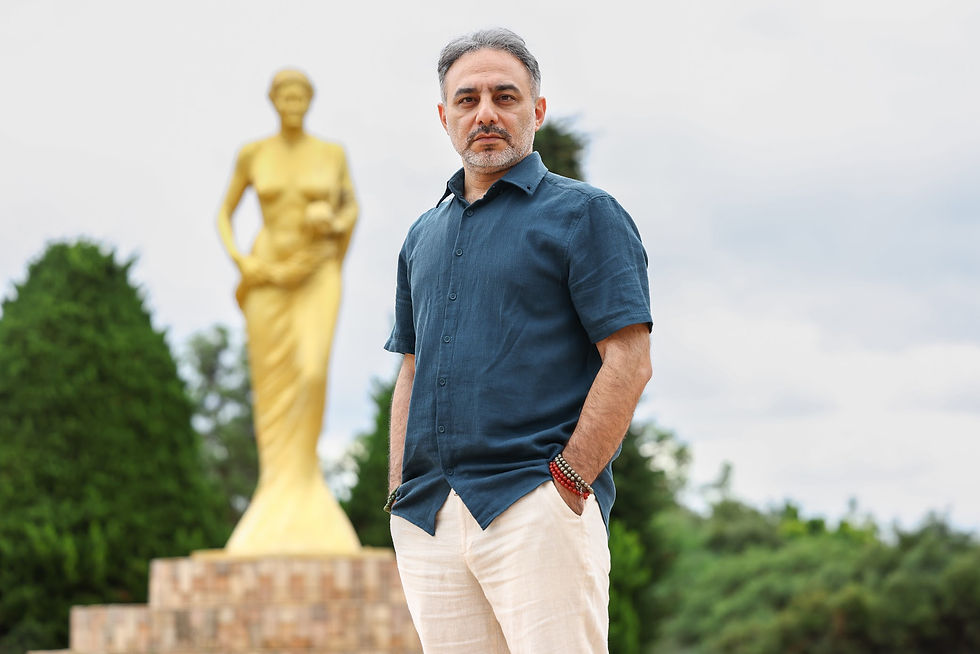
I would like to thank Mr. Etminan for agreeing to do this interview and for writing such thoughtful and insightful answers to my questions! The editing work is amazing, and it is another great film by director Jafar Panahi! Make sure to check out one of the most powerful films of 2025 when you get the chance, which is now playing in theaters. It is also up for your consideration for this year's Academy Awards in all eligible categories, including Best Picture, Best International Feature Film and Best Editing.
Cast & Crew:
Director: Jafar Panahi
Cast: Vahid Mobasseri, Ebrahim Azizi, Madjid Panahi, Maryam Afshari, Hadis Pakbaten, Mohamad Ali Elyasmehr
Cinematography: Amin Jafari
Editing: Amir Etminan
Producers: Philippe Martin, Jafar Panahi
Production Companies: Les Films Pelléas, Jafar Panahi Productions, Pio & Co, Bidibul Productions, ARTE France Cinéma
Production Designer: Leila Naghdi
Screenplay: Jafar Panahi
Sound: Valérie de Loof, Nicolas Leroy, Abdoreza Heidari, Cyril Holtz
US Distributor: NEON


Comments